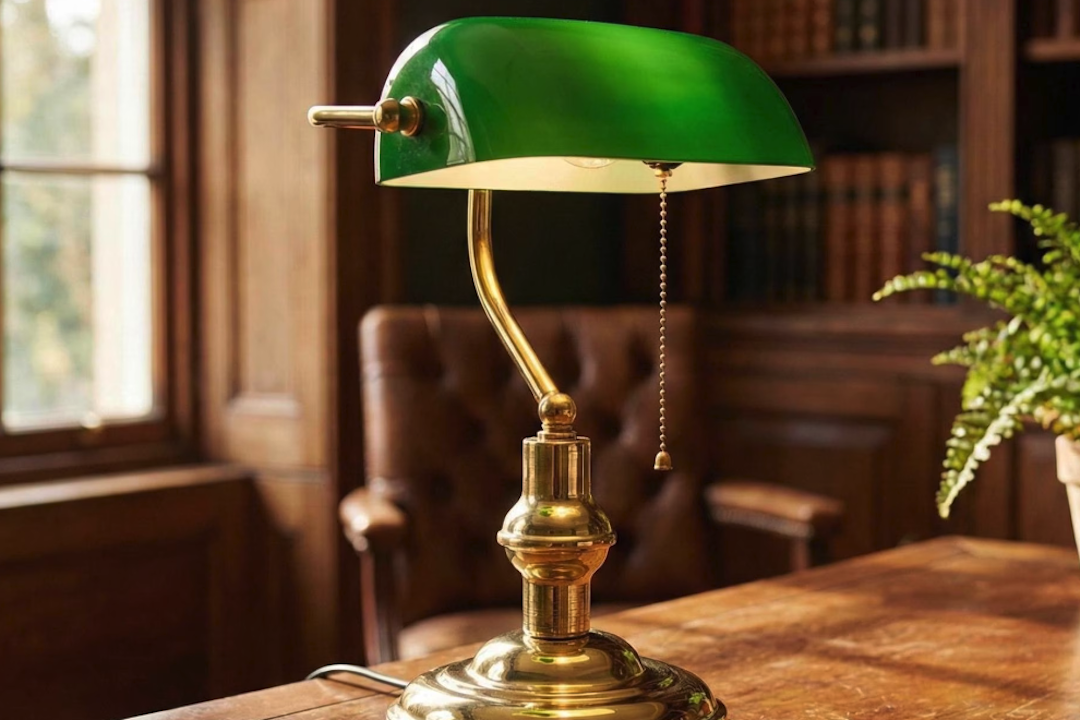


Ever wondered what that iconic green glass lamp on old movie desks is called? It’s a “Banker’s Lamp,” or more formally, a “Classic American Vintage Green Glass Banker Table Lamp.” These distinctive lamps, with their polished brass or bronze bases and their signature green glass shades, have been a staple in offices, libraries, and studies for well over a century. They’re more than just a light source; they’re a piece of history and a symbol of a bygone era of meticulous work and thoughtful design.
You might think the green shade is purely aesthetic, but there’s a practical, historical reason behind it.
Glare Reduction and Eye Strain
In the late 19th and early 20th centuries, incandescent light bulbs were relatively new and often quite harsh. They produced a bright, yellowish light that could cause significant eye strain during long hours of work. The green glass shade served a crucial purpose: it filtered this harsh light. Green is a color that falls in the middle of the visible light spectrum, making it less disruptive to the human eye.
Psychological Impact of Green
Beyond its physical properties, green is also known for its calming and concentration-enhancing qualities. Imagine working under a bright, unfiltered light for hours versus a soft, green glow. The latter contributes to a more focused and less fatiguing environment, which was highly valued in professions like banking, law, and academia where intense, prolonged reading and writing were common.
Enhancing Contrast
The green light also subtly enhanced the contrast between black ink on white paper. While not as dramatically effective as modern optical filters, it was a noticeable improvement over bare bulbs, making long documents easier to read and reducing the need for constant refocusing. This was particularly important before the widespread adoption of computers and digital documents.
A Brief History of an Iconic Design
Understanding the lamp’s origins sheds light on its enduring appeal. It wasn’t just a random design; it met a genuine need.
The Emergence of Desk Work
The late 19th century saw a significant shift in the nature of work. As industries grew and complex financial systems developed, desk-bound professions flourished. Bankers, lawyers, accountants, and writers spent increasingly long hours hunched over documents, ledgers, and books. This increased demand for practical, efficient, and comfortable lighting solutions for individual workspaces.
Harrison D. McFaddin and the “Emeralite”
The most famous iteration of the Banker’s Lamp Xlightings was patented by Harrison D. McFaddin in 1909 and marketed under the brand name “Emeralite.” The term “Emeralite” itself combined “emerald” (referencing the distinctive green shade) and “light.” These lamps quickly became synonymous with quality and function.
Early Manufacturing Processes
The original Emeralite lamps featured hand-blown glass shades, often with a white interior layer to reflect light downwards more efficiently, and sturdy brass or bronze bases. The manufacturing process was meticulous, contributing to their durability and premium feel. Early models often had a pull-chain switch, a common feature of the era.
Evolution and Adaptations
While the Emeralite is the most recognizable, many other manufacturers produced similar lamps. The basic design—a heavy base for stability, a flexible neck or adjustable shade, and the iconic green glass—was replicated and adapted. Materials varied, from polished brass to painted metal, and shade designs sometimes incorporated additional decorative elements.
Beyond the Desk
While primarily a desk lamp, its design was so successful that variations appeared in other settings. Smaller, more compact versions for personal studies, and even larger, more ornate models for executive offices, all maintained that familiar silhouette and green glow.
Characterizing an Authentic Vintage Banker’s Lamp
If you’re looking to acquire a genuine vintage piece, knowing what to look for is key. There’s a big difference between an authentic antique and a modern reproduction.
The Shade: The Heart of the Lamp
The green glass shade is the defining feature. For true vintage pieces, pay attention to its construction.
Hand-Blown Glass vs. Molded Glass
Older shades, especially those from the early 20th century, often exhibit characteristics of hand-blown glass. You might see subtle imperfections, variations in thickness, or a slightly uneven edge. Modern reproductions are typically machine-molded, resulting in perfectly uniform and flawless glass. Some vintage shades might also feature a “fired-on” green coating on clear glass rather than solid green glass.
Internal White Layer
Many original Banker’s Lamps, particularly Emeralites, had a white opaque or frosted glass lining on the interior of the green shade. This white lining served to maximize the downward reflection of light onto the work surface, preventing light leakage upwards and making the lamp more efficient. If the interior is just plain green, it might be a later reproduction or a different manufacturer’s design.
The Base and Fixtures: Solid and Substantial
The base and other metal components are equally important indicators of authenticity.
Material and Weight
Vintage Banker’s Lamps invariably have substantial, heavy bases made from solid brass, bronze, or cast iron. This weight provided stability and prevented accidental tipping, a crucial feature for a desk lamp. If the lamp feels light or hollow, it’s likely a modern reproduction using cheaper, lighter materials like plated steel or aluminum. The finish on old brass or bronze will also show natural patina, tarnishing and wear over time, which is difficult to perfectly replicate.
Wiring and Electrical Components
Original wiring in vintage lamps will be cloth-covered and likely brittle. While charming, it’s a safety hazard and should always be replaced by a qualified electrician if you plan to use the lamp regularly. The switch mechanism is also a good clue. Pull-chain switches were common, as were rotary switches on the base or socket. Modern lamps often have push-button or inline cord switches.
Markings and Patina
Look for manufacturing marks or patent numbers, particularly on the base or socket. Emeralite lamps often have their name stamped. The metal parts should also show a natural patina—the result of oxidation over decades. This isn’t just dirt; it’s a rich, deep discoloration that adds character and can’t be easily faked. Aggressively polished “vintage” lamps might have lost some of this important historical evidence.
The Banker’s Lamp in Modern Decor
Even in the age of LED backlighting and minimalist design, the Banker’s Lamp holds its own. It’s a statement piece that blends history with practicality.
A Touch of Classic Elegance
In an increasingly digital and fast-paced world, the Banker’s Lamp offers a tangible connection to the past. Its classic lines and warm glow inject a sense of gravitas and timeless elegance into any room. It’s perfect for those who appreciate traditional aesthetics and quality craftsmanship.
Versatility in Styling
While classically associated with traditional or academic interiors, the Banker’s Lamp is surprisingly versatile.
Traditional and Eclectic Styles
Naturally, it shines in traditional libraries, studies, and offices, complementing dark wood, leather, and antique furnishings. It also works beautifully in eclectic spaces, providing a grounded, historical element amidst more contemporary pieces, creating a fascinating contrast.
Modern Home Offices and Reading Nooks
Even in a minimalist or industrial office, a Banker’s Lamp can provide a welcome pop of color and a touch of warmth. Its focused downward light is still ideal for reading or detailed work, making it a functional choice for a modern home office desk or a cozy reading nook. It can serve as a deliberate nod to historical design within a modern context.
Beyond the Desk
Don’t limit yourself to the desk! A smaller Banker’s Lamp can make an excellent accent light on a side table in a living room, a bedside table in a bedroom for late-night reading, or even a console table in an entryway, offering a sophisticated welcome.
Maintenance and Care for Your Vintage Gem
Owning a vintage Banker’s Lamp is a bit like owning a classic car – it requires a little love and attention to keep it looking its best and functioning safely.
Electrical Safety First
This is paramount. If you acquire a truly vintage model, assume the wiring is unsafe until proven otherwise. Old cloth-covered wiring can fray, crack, and become a fire hazard.
Rewiring
Hiring a qualified electrician to inspect and, if necessary, rewire the lamp is the safest option. They can replace old wiring with modern, insulated cords while preserving the lamp’s original aesthetic where possible, especially with the pull-chain or rotary switch mechanisms. This also often involves replacing the original plug with a safer, grounded one.
Cleaning the Metal Components
The metal base and arm will likely develop a patina over time. Decide if you want to preserve this historical finish or restore the lamp to its original shine.
Preserving Patina
If you like the aged look, simply dust regularly with a soft, dry cloth. For a deeper clean, a slightly damp cloth followed by a thorough drying can remove surface grime. Avoid abrasive cleaners, as they can strip the patina. Some collectors even apply a thin coat of museum wax to protect the existing patina.
Restoring Shine
If you prefer a polished look, use a brass or bronze cleaner specifically designed for antique metals. Follow the product instructions carefully, and work in a well-ventilated area. Be gentle, as overly aggressive polishing can damage the metal or remove fine details. It’s often a good idea to perform a small test in an inconspicuous area first.
Caring for the Glass Shade
The green glass shade is fragile and needs careful handling.
Gentle Cleaning
Dust the shade regularly with a soft, lint-free cloth. For a more thorough cleaning, carefully remove the shade from its fixture (if possible) and wash it gently in warm, soapy water with a mild dish soap. Rinse thoroughly and dry completely with a soft cloth to avoid water spots. Pay special attention to the interior if it has a white lining, as dust can accumulate there.
Avoiding Damage
Never use abrasive cleaners or harsh chemicals on the glass, as they can scratch or dull the finish. Be extremely careful when handling the shade, as even a gentle bump can cause chips or cracks. If the shade is particularly old, it may have inherent stress fractures from the original blowing process, making it even more delicate.
Bulb Choice
While the original purpose of the green shade was to mellow tungsten filament light, modern LED bulbs offer a great alternative.
LED Bulbs
Choose an LED bulb with a warm color temperature (around 2700K to 3000K) to replicate the cozy glow of older incandescent bulbs. This will provide energy efficiency, longevity, and less heat output, which is safer for vintage wiring (once rewired) and the glass shade. Avoid overly bright or cool-toned LEDs, as they can detract from the lamp’s classic aesthetic. Look for bulbs designed for dimming if your lamp has a dimmer, or consider a lower wattage equivalent for a softer ambiance.